
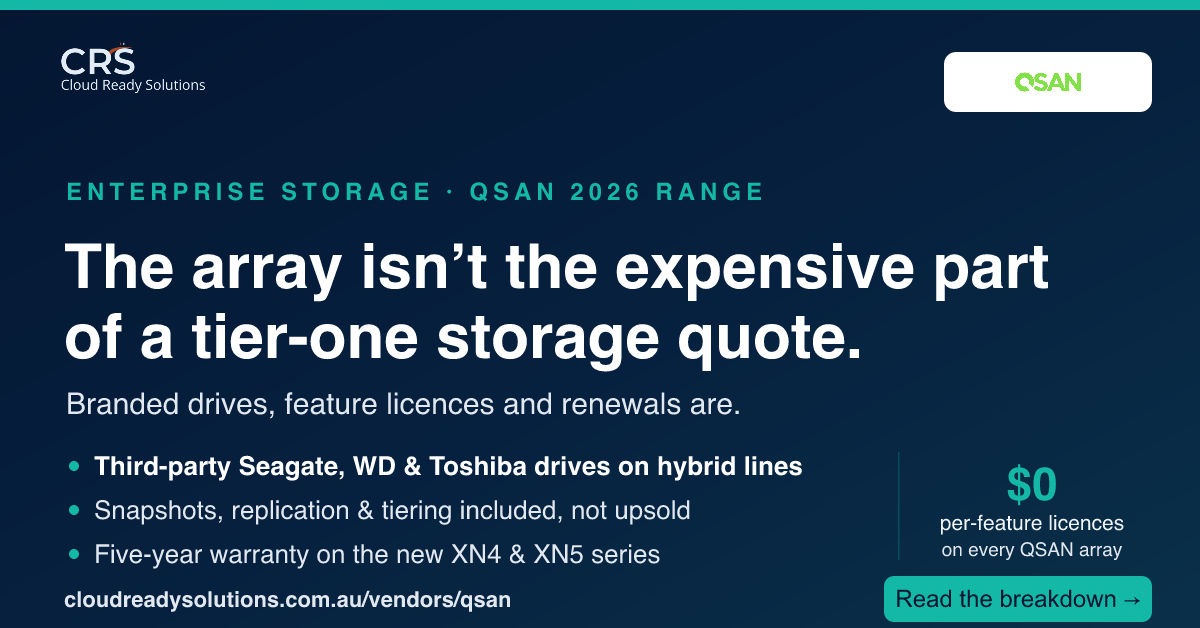
Get a storage quote from one of the big brands and the array itself can look surprisingly reasonable. The cost arrives later. Once the array is in the rack, every terabyte you add for the rest of its life comes from the vendor, at the vendor's price, and it is often the same physical spindle you could buy on the open market for far less. Support renewals climb year on year once the vendor knows that moving away would cost you more than staying. Some platforms charge separate software licences for features on top of that.
QSAN sells it differently, and that, more than anything technical, is why the brand is in our lineup. The company has been building storage in Taiwan since 2004. Current arrays are dual active-active, certified for VMware and Hyper-V, with a six-nines availability rating on the XCubeSAN line and the new XN unified series. You buy the box, the software comes with it, and on most of the range you can put your own drives in.
The drive question
XCubeSAN, XCubeNXT and XCubeNAS take third-party drives. QSAN publishes compatibility lists for Seagate, Western Digital and Toshiba. When a system needs another 200TB in year three, the drives cost whatever the market is charging in year three, and on a growing system that can end up mattering more than the price of the arrays themselves.
The all-NVMe products don't work this way. The XF series and the NVMe XN models take QSAN-qualified NVMe drives only, the same policy Pure and Dell run on their flash platforms, on the same grounds of drive firmware behaviour at very low latency. If you want the bring-your-own-drives economics, you're buying the hybrid lines.
There's a published QSAN case study where the drive point plays out. IBRAE, a nuclear-safety research institute, chose the XS5224-D for an HPC cluster and named predictable upgrade costs from third-party HDD support as part of the reason. The same install attached the Fibre Channel storage direct to the hosts and never bought FC switches at all.
Software licences don't really come into a QSAN quote either. Snapshots, replication (sync and async), auto-tiering, WORM, thin provisioning and the QSLife SSD health monitoring all come with the array.
What the May 2026 refresh added
QSAN reworked most of the range in May. We spent early July getting our catalogue and comparison pages square with the new collateral.
The new XN3, XN4 and XN5 unified series is the headline: dual-active NVMe platforms doing block and file out of one system. Warranty is five years on the XN4 and XN5, three on the XN3. We now size these first for virtualisation clusters that want LUNs and file shares without running two boxes.
A few smaller things came in the same refresh. QSM 4 can replicate between the unified and block families, and a DR pair no longer needs matched hardware at both ends. QSeal air-gapped backup landed, though only on the QSM platform; immutability shoppers should look at the XN series. There's a 78-bay expansion shelf now, an NVMe-oF JBOF called the XE5 pitched at AI training, and the KS2, an on-prem Kubernetes appliance clustering to 8 nodes that will mostly interest people rethinking Tanzu after Broadcom. The XF5 flash flagship carries the performance numbers. QSAN's datasheet says 50,000 random-write IOPS at 100 microseconds on PCIe Gen4, and we've gone through how that stacks up against Pure FlashArray separately.
Integration didn't change. VAAI, ODX, a CSI driver, and plain iSCSI and NFS that a Proxmox cluster mounts without any special handling. Proxmox comes up a lot in partner quotes lately.
Who else runs it
QSAN hasn't spent what Dell spends on brand awareness in Australia, so buyers usually want to know who trusts it with production data.
The reference we usually lead with is Taoyuan International Airport: XCubeSAN under the flight information and surveillance systems, expanded over the years without downtime, per the published case study. Airports don't buy storage casually. Tolomy, a UK cloud provider, is the other one worth reading, mostly because its clients include the Ministry of Justice and government VDI is an unforgiving workload. QSAN also publishes a TaiDoc write-up if medical-device R&D is closer to home.
Warranty runs through local partners. Next-business-day parts are available in the major Australian cities, and escalations come to our engineers first, in Australian business hours.
If a refresh is on your desk
Send us the workload numbers and we'll size a QSAN option against whatever you've been quoted. We do the pre-sales engineering in-house at CRS, from workload profiling through to drive layout and replication design, and we'll fit it around whatever backup platform you already run. Veeam integration is certified on QSAN's side. NAKIVO works fine over standard iSCSI or SMB targets. And if tier-one is genuinely the right answer for you, say a multinational footprint that needs one vendor's support everywhere, or a hard dependency on a NetApp or Dell ecosystem integration, we'll tell you that instead.
Resellers and MSPs can quote the range through the CRS partner portal, and deal registration is there for opportunities you bring us. The QSAN vendor page has the family-by-family breakdown, and there are Dell PowerVault and HPE MSA head-to-heads in the comparison library.